A model for explaining reactions
The session presents a three-system model of the brain as a way to explain reactive, emotional, and intentional parenting. It is the instructor’s teaching model for making reactions understandable. This module presents it in those terms, not as a complete account of neuroscience.
Survival, emotional, and thinking systems
Each system is given a distinct role in the model.
- Reptilian or survival brain: the oldest system, linked to perceived safety or danger, black-and-white evaluation, automatic reactions, and fight, flight, or freezing.
- Limbic or emotional brain: linked to emotions, experiences, and memories, including the amygdala and hippocampus.
- Neocortex or prefrontal cortex: the thinking system, linked to planning, decision-making, problem-solving, understanding others, and emotional regulation.
A threat does not have to be physical
The instructor distinguishes emotional danger from physical danger. A child ignoring an instruction can feel like a threat to a parent’s respect, control, or social standing, even though nobody is physically at risk. The survival response can switch on anyway.
The supermarket tantrum
In the session’s example, a child has a tantrum in a supermarket. The parent feels judged and out of control, and may threaten to leave the child or react harshly to regain control. The model explains the reaction without excusing it: the parent is responding to a perceived social threat. The session’s warning is direct: do not threaten to leave a child during a public tantrum merely to regain social control.
The model in the course deck
The course slide deck presents the same three systems and a simple illustration of three brain states. The illustration’s labels differ slightly from the session’s names: a survival state linked to the brain stem, an emotional state linked to the limbic system, and an executive state linked to the prefrontal lobes. Like the session’s model, it is a teaching picture rather than a complete account of neuroscience.
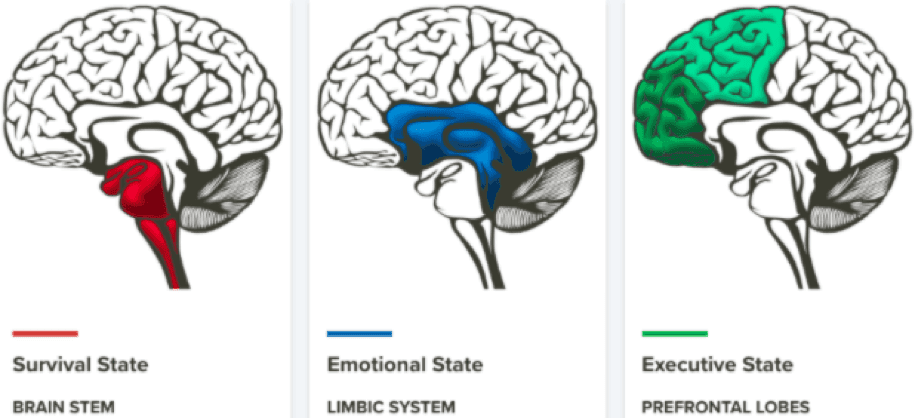
Which brain is in charge?
The deck gives each system a parenting example and a way to shift toward the thinking brain. For the reptilian brain, its tip is to pause for five seconds before reacting.
| Brain system | Function | Parenting example | Shift toward the neocortex |
|---|---|---|---|
| Reptilian (survival) brain | Basic survival functions and fight-or-flight; reacts instinctively to stress | A parent yells immediately when a child misbehaves because they feel overwhelmed | Pause, breathe, and ask: “What is my child learning from this reaction?” |
| Limbic (emotional) brain | Emotions, memory, and social bonding | A parent feels guilty after scolding and overcompensates with gifts | Remember that boundaries and discipline are acts of love |
| Neocortex (thinking) brain | Logic, reasoning, problem-solving, and decision-making | A parent pauses and calmly discusses the behaviour instead of punishing impulsively | Guide the child to understand their actions rather than just punishing |