The cost build-up
The Week 2 cost logic is kept. Books at an average of USD 3 each come to USD 6,000. Adding USD 400 for packaging, USD 1,000 for domestic transport and USD 600 for coordination and inspection gives a base estimate of USD 8,000. Contingency of 15% of that base adds USD 1,200, so the maximum cash budget is USD 9,200. The allowances are planning assumptions, not market quotations or verified local prices.
| Cost component | Planning basis | USD |
|---|---|---|
| Books | 2,000 books at USD 3 average | 6,000 |
| Packaging | Protective cartons and packing materials | 400 |
| Domestic transport | Supplier collection and school distribution | 1,000 |
| Coordination and inspection | Local operational support | 600 |
| Base estimate | Sum of the four allowances | 8,000 |
| Contingency | 15% of the USD 8,000 base | 1,200 |
| Maximum cash budget | Base plus contingency | 9,200 |
Contingency sits inside the ceiling
The 15% applies to the base, not to the USD 9,200 total, and contingency must not be added twice. It is inside the ceiling: not extra funding, and not an allowance for extra scope.
- Using it needs a recorded justification and the approvals set out in the charter's authority section.
- It is not a spending target. Unused funds stay with the sponsor.
- Supplier and transport quotations must include applicable charges before commitments are approved. Taxes and fees are not assumed to be zero.
Time given in-kind
A small coordination allowance would mislead if readers thought it covered six weeks of professional salaries. The charter therefore assumes that the sponsor, the Project Manager and the school representatives contribute time in-kind, recorded separately from the cash budget. The USD 600 allowance covers local operational support only.
Applied choiceThe in-kind assumption is the author's addition for this case. If essential participants need paid time or travel, the estimate must be revisited, and unpaid effort still has workload and availability limits.
Six weeks from authorization
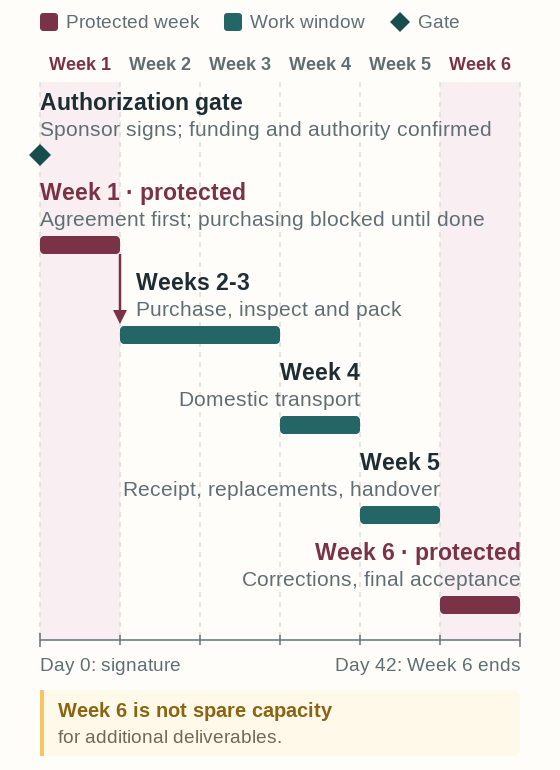
The clock starts at signature. Week 1 begins on the authorization date and Week 6 ends 42 calendar days later, so no start date is invented. Purchasing happens only after requirements are agreed, and receipt is targeted for Week 5 so that Week 6 can absorb corrections. In the charter's words, Week 6 is “not spare capacity for additional deliverables”. Local stock and a single district make six weeks plausible, but not guaranteed.
| Period | Milestone or completion evidence |
|---|---|
| Authorization | Sponsor signs; funding and delegated authority confirmed |
| Week 1 | Schools, book list, allocation and quotations confirmed |
| Weeks 2-3 | Approved books purchased, inspected and packed |
| Week 4 | Domestic transport and distribution undertaken |
| Week 5 | School receipt, replacements and handover completed where possible |
| Week 6 | Delay allowance, outstanding corrections and final acceptance completed |
Assumption, constraint, dependency, risk
The guide gives one example of each term from this project. The distinction between the terms follows the deck; the examples are applications to the case.
| Term | Example in this project |
|---|---|
| Assumption | Suitable books will be available from in-country stock |
| Constraint | The project must remain within USD 9,200 |
| Dependency | School agreement must precede purchasing |
| Risk | The assumed stock or price may not be available when required |
Fixed constraints and preconditions
The fixed planning constraints are 2,000 accepted books, four schools, six weeks and USD 9,200. Two conditions come before any commitment.
- Funding availability is a precondition to authorization.
- Week 1 confirmation of stock, quotations, school participation and delivery access is a prerequisite to purchasing.
- If these assumptions fail, the Project Manager will seek a sponsor decision rather than silently reduce quantity, quality or coverage.