A provisional, role-based list
The stakeholder list is role-based and provisional; named representatives will be recorded during initiation. Power and interest describe anticipated influence, not confirmed assessments. Beneficiaries are included, not only the people who pay or deliver.
| Stakeholder | Importance and role | Power and interest | Engagement |
|---|---|---|---|
| Client or sponsor | Provides funding, owns the charter, approves major decisions and final acceptance | High / high | Weekly reporting and timely decisions |
| Project Manager | Integrates scope, cost, schedule, quality and stakeholder coordination; accountable for reporting and escalation | High within delegation / high | Continuous coordination |
| Local NGO education and logistics coordinators | Connect schools, validate needs, manage distribution, verify handover evidence | High / high | Regular operational engagement |
| Four school heads and teacher representatives | Specify suitable books, approve allocations, sign receipt, set up pupil access and custodianship | High over acceptance / high | Consult before purchase and at handover |
| Pupils and parents, the beneficiaries | Their needs determine usefulness and access; teachers pass on feedback without unnecessary personal-data collection | Low formal power / high | Involvement maintained through schools |
| Suppliers and domestic carrier | Provide conforming stock, packing or transport and agreed replacement arrangements | Medium / high | Confirm orders, dates and exceptions |
| Community leaders and local education representatives | Support access, coordination and any locally required institutional agreement | Potentially high / medium | Consult during Week 1 |
| Sponsor finance representative | Verifies funding, commitments, payments and final reconciliation | Medium / high | Weekly financial review |
The case on the grid
On the deck's power/interest grid, four roles need regular engagement: the sponsor, the Project Manager, the NGO coordinators and the school representatives. Pupils and parents sit in Maintain Interest. The suppliers and carrier, and the sponsor's finance representative, are rated medium power, so they sit on the power midline on the high-interest side. Community leaders are rated potentially high power with medium interest, so they sit on the interest midline in the upper half. No role falls in Keep Informed.
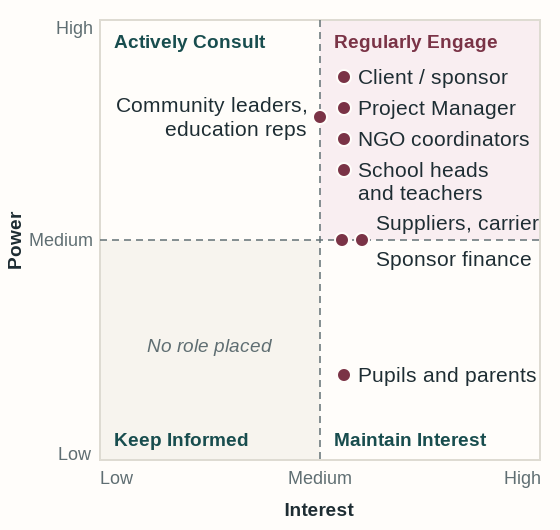
Read with careThe charter rates some stakeholders medium or potentially high, while the deck's grid has only low and high. The figure places those roles on the midlines instead of choosing a quadrant. This observation was made for this module; it is not a point from the guide.
From the deck's list to the charter's columns
The deck lists what a charter records about stakeholders, and each item has a place in the charter's table.
- Names or roles become the role-based list.
- Position becomes the stakeholder and position column.
- Influence and interest level become the power and interest ratings.
- Primary concerns become the importance and role column.
- Engagement needs become the engagement notes.
Power, interest and legitimacy
The sponsor controls funding and authorization, and the schools control suitability and receipt, so both need regular involvement. Pupils and parents have little formal power but a strong stake. Their needs should reach the project through the schools rather than be overridden by donor preference.
- The salience model's attributes, legitimacy, power and urgency, explain why a group without budget authority still deserves attention.
- A school's urgent concern about suitability matters even when the sponsor wants a fast shipment.
- The charter uses that insight without adding a second full stakeholder model.
Acceptance evidence
The Project Manager will submit evidence against all six objectives. Final acceptance requires 2,000 conforming books, complete school handovers and access verification, packaging evidence, resolved discrepancies, and reconciled spending within the ceiling. The sponsor approves closure and the schools keep ongoing custody. Any unmet objective must be disclosed, not described as achieved.
Three decisions at three times
The sponsor's signature authorizes the project, its cash ceiling and the delegated authority. It is not final delivery acceptance, and it does not waive later purchasing approvals. The case separates three decisions.
- First, the sponsor's signature authorizes the initiative.
- Later, school signatures verify receipt.
- Last, final sponsor acceptance closes the project.
Prospective, not achieved
The charter's targets must not be described as already achieved. Achievement is assessed at closure against the defined evidence, which is why the wording is deliberately prospective: will, requires, proposed. A real sponsor would need named partners, validated quotations and confirmed capacity before the proposal could become an operational commitment.
The case in one paragraph
The Week 2 objectives were expanded into a charter rather than replaced. The books, schools, six-week duration and cash ceiling were kept, and scope boundaries, acceptance evidence, risks, stakeholder roles and decision limits were added. The sponsor authorizes the project, and the Project Manager manages it within delegated authority. The estimates and thresholds are explicit assumptions to validate, not claims of work already completed.
Carry it into your own projects
The book initiative yields six principles that transfer to other projects.
- Count accepted results, not dispatched cartons.
- Get recipient agreement on content before buying.
- Exclude adjacent work explicitly.
- Verify quality before anything counts toward delivery.
- Delegate spending and scope within limits.
- Treat receipt and closure as separate decisions.