Preserve the network as well as the crew requirements
A and B can start immediately. C waits for both A and B. D waits for B. E waits for C and D. The durations are four weeks for A, three for B, one for C, five for D and four for E. Their crews are three, five, six, eight and seven workers respectively. The organization can supply at most nine workers per week. Total work is duration multiplied by crew size for each activity. A requires twelve worker-weeks, B fifteen, C six, D forty and E twenty-eight. Together they require 101 worker-weeks. These quantities describe the supplied example; changing a crew size or splitting an activity would need an explicit assumption about how its duration and execution can change.
| Activity | Predecessors | Weeks | Workers | Worker-weeks |
|---|---|---|---|---|
| A | None | 4 | 3 | 12 |
| B | None | 3 | 5 | 15 |
| C | A and B | 1 | 6 | 6 |
| D | B | 5 | 8 | 40 |
| E | C and D | 4 | 7 | 28 |
Passing the total-capacity test is only a first screen
Let W be required worker-weeks, D the target number of weeks, and R the available workers each week. The first necessary condition is W less than or equal to D times R. For twelve weeks and nine workers, capacity is 108 worker-weeks. Required work is 101, so the project passes this first screen. Passing means it might be feasible. Dependencies and the timing of demand can still prevent the team from using that capacity. Unused workers in an early week cannot be stored and added to the crew available in a later week. A total shortfall rules a target out; a sufficient total does not automatically validate it.
Calculation from the sourceRequired work: 101 worker-weeks. Twelve-week capacity: 12 × 9 = 108 worker-weeks. Since 101 ≤ 108, check the actual schedule next.
Both early and late starts can overload the crew
In the early-start schedule, A runs in weeks one to four, B in weeks one to three, C in week five, D in weeks four to eight and E in weeks nine to twelve. Demand is eleven workers in week four because A and D overlap. It reaches fourteen in week five because C and D overlap. Both exceed nine. Weeks one to three each leave one worker unused. The late-start schedule places A in weeks four to seven and C in week eight, while B, D and E keep their displayed weeks. Demand is eleven in weeks four to seven and fourteen in week eight. E uses seven workers in each of weeks nine to twelve, leaving two unused each week. Moving everything to its late dates therefore does not solve the resource problem.
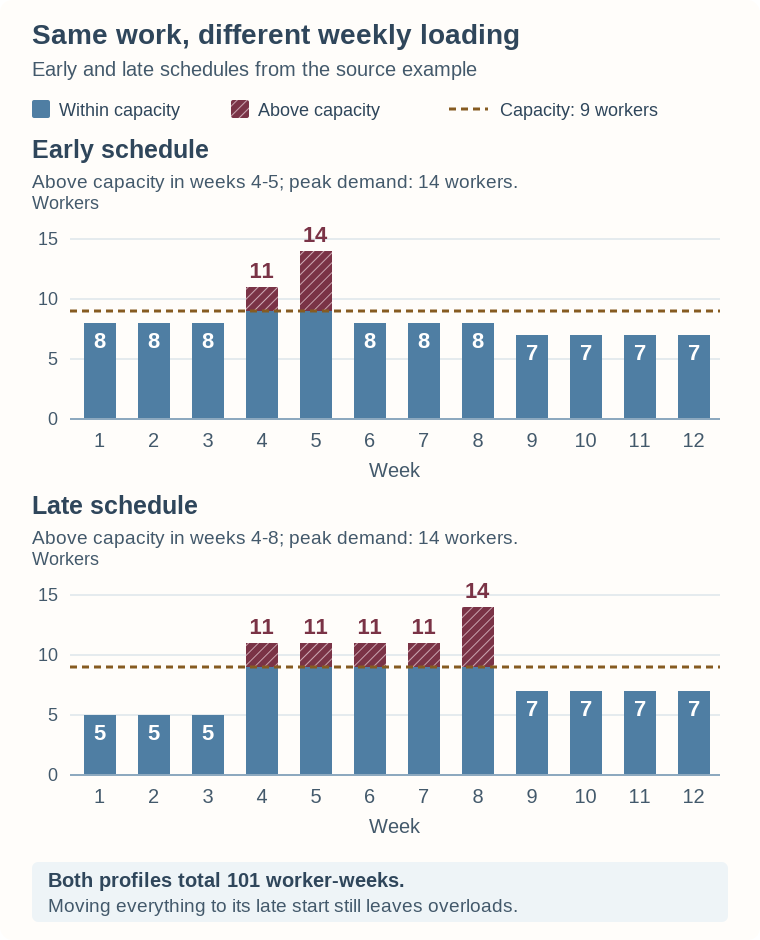
| Schedule | 1 | 2 | 3 | 4 | 5 | 6 | 7 | 8 | 9 | 10 | 11 | 12 |
|---|---|---|---|---|---|---|---|---|---|---|---|---|
| Early start | 8 | 8 | 8 | 11 | 14 | 8 | 8 | 8 | 7 | 7 | 7 | 7 |
| Late start | 5 | 5 | 5 | 11 | 11 | 11 | 11 | 14 | 7 | 7 | 7 | 7 |
Read with careWorker demand is per week. The area under either profile is 101 worker-weeks, not 101 workers.
Use the refined bound with its units and limitations
The deck takes three unavoidable unused worker-weeks at the early end and eight at the late end, and writes W less than or equal to D times R minus those losses. With the twelve-week target, usable capacity is 108 minus three minus eight, or ninety-seven worker-weeks. That is less than 101, so the twelve-week target fails this refined test. Rearranging the source inequality gives 101 less than or equal to nine D minus eleven, so D is at least 112 divided by nine, approximately 12.44 weeks. If durations must be expressed in whole weeks, this bound rules out anything below thirteen. It does not prove that a thirteen-week resource-feasible schedule exists. A feasible schedule must still satisfy every dependency and the weekly crew limit.
Read with carePage 14 asks about eight weeks but sets D to twelve and calculates with 108 worker-weeks. This lesson identifies the displayed arithmetic as a twelve-week test. Its rE and rL quantities are worker-weeks, despite the slide calling them workers.
Key takeaways
- Multiply duration by crew size, then sum, to obtain total worker-weeks.
- 101 ≤ 108 passes a total-capacity screen but does not establish feasibility.
- A valid network schedule can overload a finite crew.
- The 12.44-week result is a lower bound, not an approved delivery promise.