Both terminal branches must finish
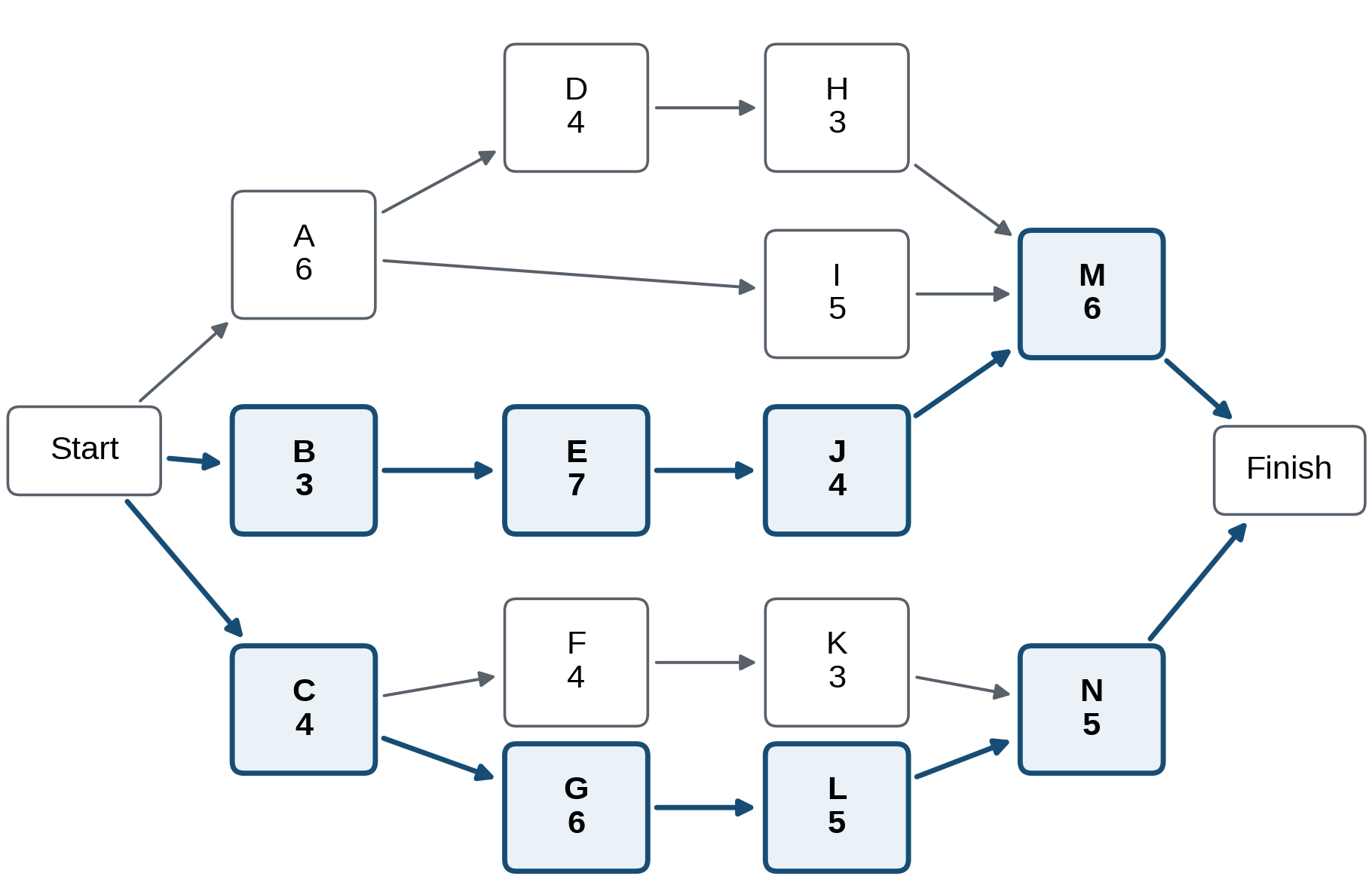
All relationships in Exercise 1 are finish-to-start with zero lag. The completed network has five routes. A–D–H–M totals nineteen weeks. A–I–M totals seventeen. B–E–J–M totals twenty. C–F–K–N totals sixteen. C–G–L–N totals twenty. Both M and N must finish, so the project duration is twenty weeks and the critical paths are B–E–J–M and C–G–L–N. Ken's twenty-week deadline is met exactly under the stated fixed durations. There is no project time reserve. This result describes the deterministic schedule; it does not give a probability of on-time completion or guarantee that the estimates will occur.
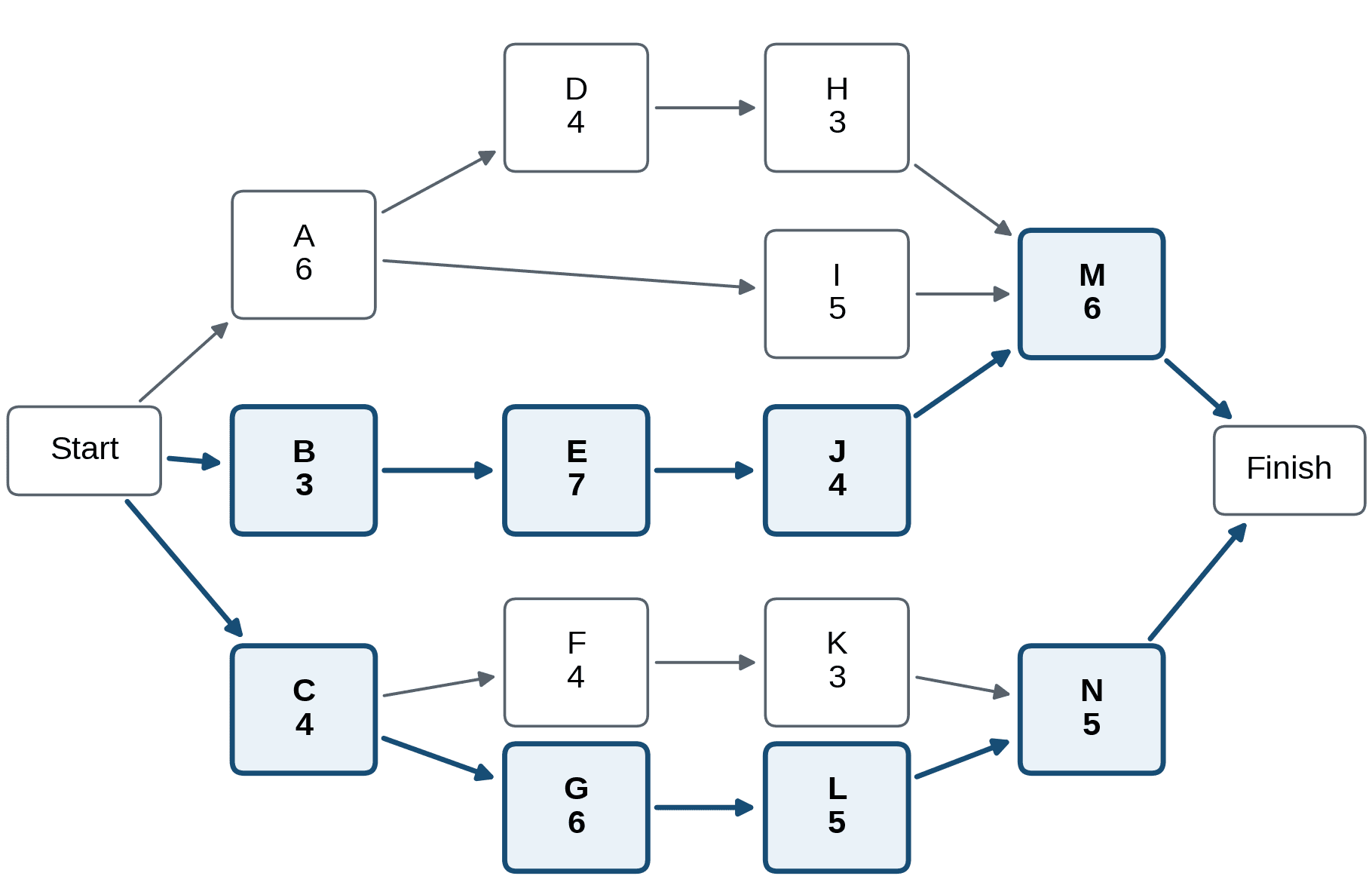
| Route | Duration calculation | Weeks |
|---|---|---|
| A–D–H–M | 6 + 4 + 3 + 6 | 19 |
| A–I–M | 6 + 5 + 6 | 17 |
| B–E–J–M | 3 + 7 + 4 + 6 | 20 |
| C–F–K–N | 4 + 4 + 3 + 5 | 16 |
| C–G–L–N | 4 + 6 + 5 + 5 | 20 |
Calculate the dates at a merge
M waits for H, I and J. Their earliest finishes are thirteen, eleven and fourteen, so M starts at the maximum, fourteen, and finishes at twenty. N waits for K at eleven and L at fifteen, so it starts at fifteen and finishes at twenty. Selecting the earliest incoming finish would let work begin before all its predecessors were complete. Working backward from twenty, M must start by fourteen. I must therefore finish by fourteen. Its duration is five, so its latest start is nine. I's early start is six, giving three weeks of total float. The table records the same forward and backward process for every activity. B, E, J, M, C, G, L and N have zero total float.
| Activity | Duration | ES | EF | LS | LF | TF |
|---|---|---|---|---|---|---|
| A | 6 | 0 | 6 | 1 | 7 | 1 |
| B | 3 | 0 | 3 | 0 | 3 | 0 |
| C | 4 | 0 | 4 | 0 | 4 | 0 |
| D | 4 | 6 | 10 | 7 | 11 | 1 |
| E | 7 | 3 | 10 | 3 | 10 | 0 |
| F | 4 | 4 | 8 | 8 | 12 | 4 |
| G | 6 | 4 | 10 | 4 | 10 | 0 |
| H | 3 | 10 | 13 | 11 | 14 | 1 |
| I | 5 | 6 | 11 | 9 | 14 | 3 |
| J | 4 | 10 | 14 | 10 | 14 | 0 |
| K | 3 | 8 | 11 | 12 | 15 | 4 |
| L | 5 | 10 | 15 | 10 | 15 | 0 |
| M | 6 | 14 | 20 | 14 | 20 | 0 |
| N | 5 | 15 | 20 | 15 | 20 | 0 |
Read with careTF is total float, also called slack. Each row uses elapsed weeks from zero.
Recalculate each requested delay separately
Each delay test starts from the original schedule. If I takes two extra weeks, it finishes at thirteen. J still controls M's start at fourteen, so the project stays at twenty weeks. If H takes two extra weeks, it finishes at fifteen. M then finishes at twenty-one, one week after the deadline. If J takes two extra weeks, it finishes at sixteen and M finishes at twenty-two, two weeks late. Monitor both critical paths, and keep attention on A–D–H–M. That route is only one week shorter than the project duration. A, D and H share the same one-week flexibility; each does not own an independent week. The H scenario shows how a previously noncritical branch can become controlling.
| Change from baseline | Affected route | Project finish | Deadline effect |
|---|---|---|---|
| I adds 2 weeks | A–I–M becomes 19 weeks | 20 weeks | Still met |
| H adds 2 weeks | A–D–H–M becomes 21 weeks | 21 weeks | 1 week late |
| J adds 2 weeks | B–E–J–M becomes 22 weeks | 22 weeks | 2 weeks late |
Key ideaAn activity's effect depends on the remaining restrictions at its merge, not only on whether it was critical initially.
Key takeaways
- Completion requires twenty weeks, with two critical paths.
- M starts at fourteen because J is its latest-finishing predecessor.
- The independent I, H and J delay tests give twenty, twenty-one and twenty-two weeks.
- Near-critical branches and shared float matter when monitoring progress.