An event waits for every incoming arrow
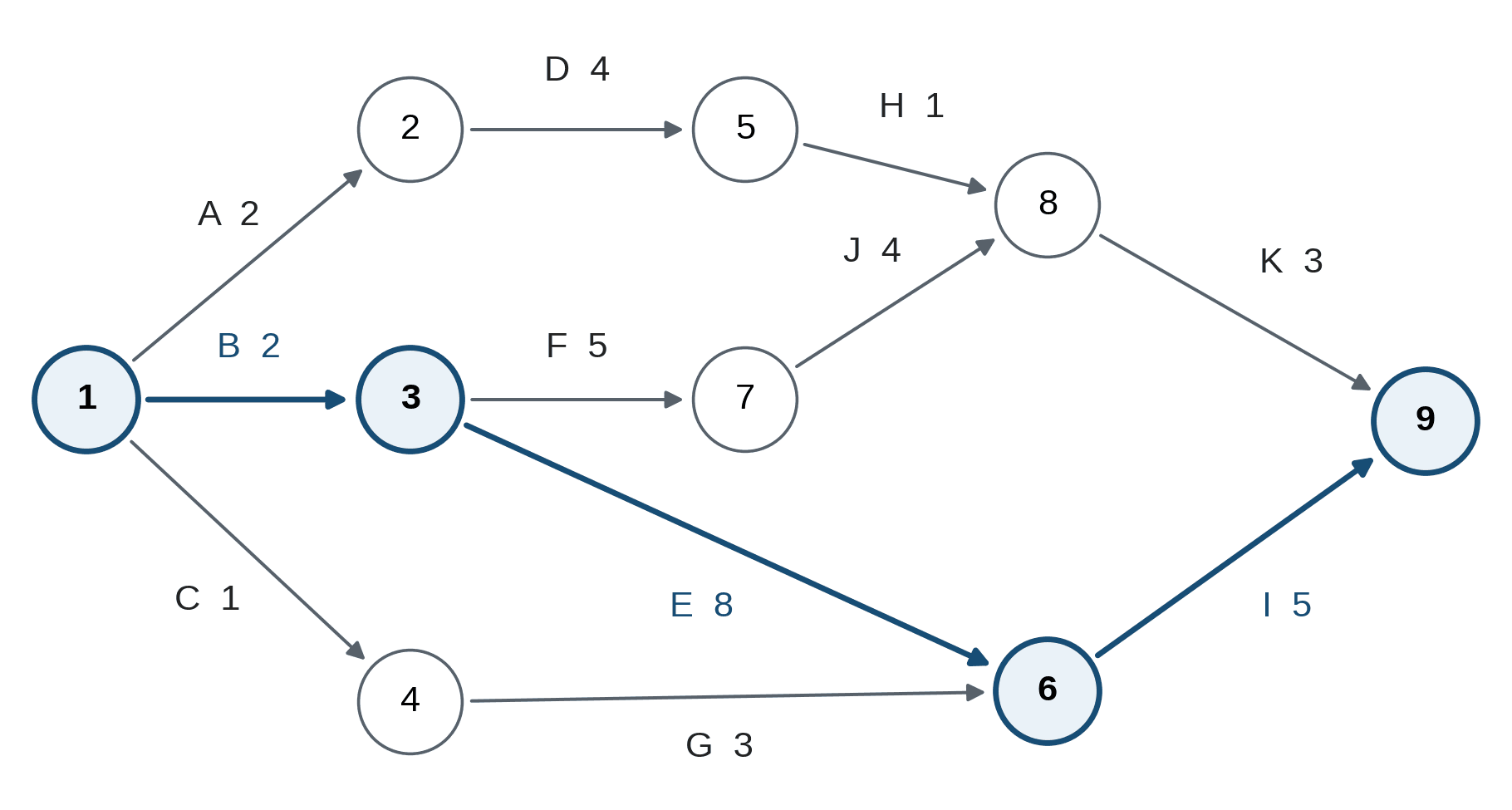
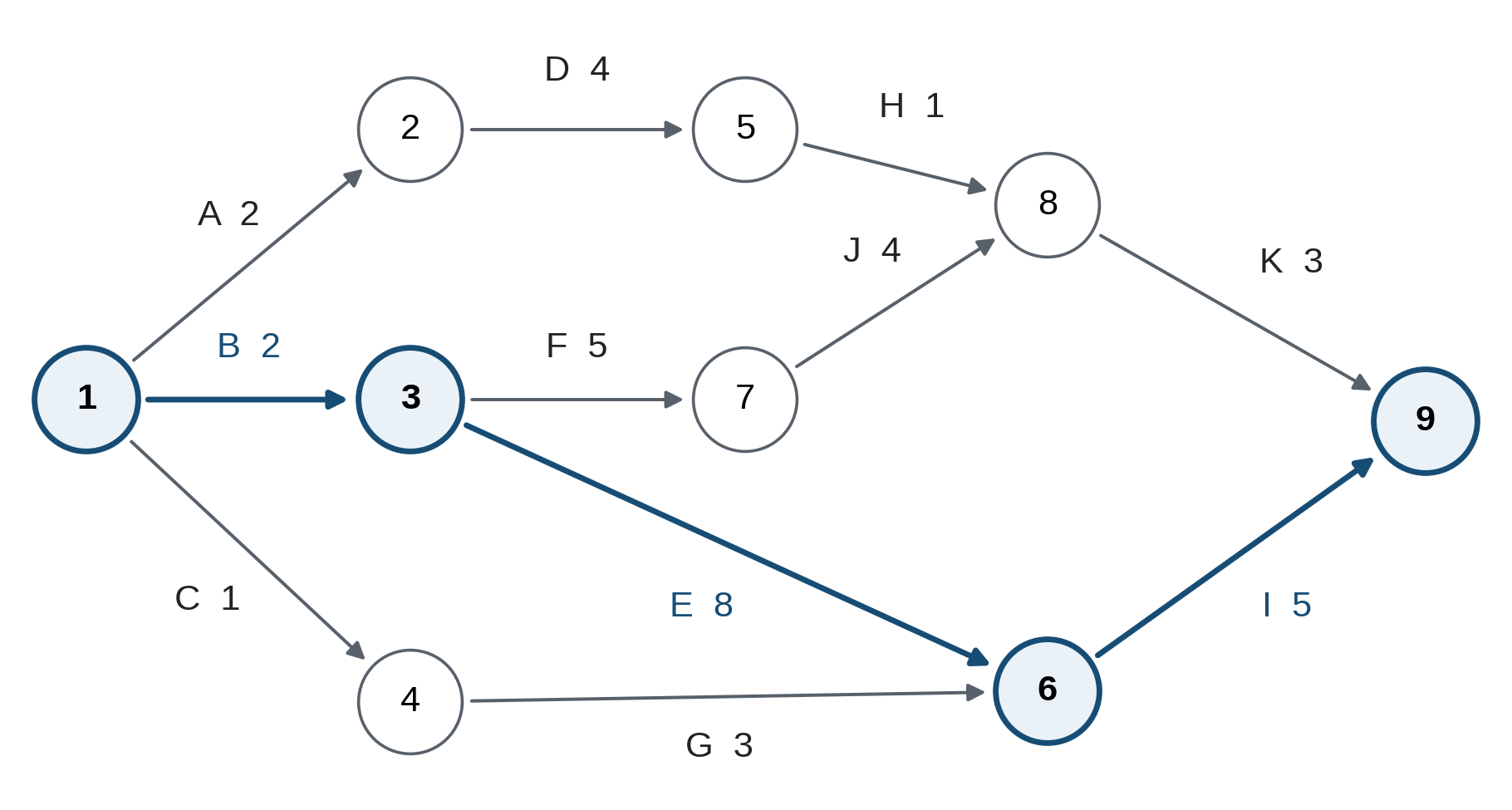
The critical route is B–E–I through events 1, 3, 6 and 9. B takes two days, E eight and I five, totaling fifteen. The other complete routes take ten days for A–D–H–K, fourteen for B–F–J–K and nine for C–G–I. The supplied network representation needs no dummy activity. Event 6 has two incoming routes. B–E reaches it at elapsed time ten; C–G reaches it at four. The event therefore occurs at ten because every incoming activity must be complete. I runs from elapsed time ten to fifteen, displayed as days 11 through 15. The event numbers are identifiers, not activity durations or day labels.
| Event | Earliest | Latest |
|---|---|---|
| 1 | 0 | 0 |
| 2 | 2 | 7 |
| 3 | 2 | 2 |
| 4 | 1 | 7 |
| 5 | 6 | 11 |
| 6 | 10 | 10 |
| 7 | 7 | 8 |
| 8 | 11 | 12 |
| 9 | 15 | 15 |
Read early and late dates on the stated day scale
Activity starts are beginning-of-day labels and finishes are end-of-day labels. E starts on day 3 and finishes on day 10: three plus eight minus one equals ten. I then starts on day 11 and finishes on day 15. B, E and I are the only activities with zero total float. Total and free float are measured in days, even though the table uses inclusive labels. G has six days of total and free float. H has five days of total float and four days of free float. K has one day of each. These values describe different relationships to the network and its early schedule; they are not separate project reserves.
| Activity | Events | Duration | ES | EF | LS | LF | TF | Free float |
|---|---|---|---|---|---|---|---|---|
| A | 1–2 | 2 | 1 | 2 | 6 | 7 | 5 | 0 |
| B | 1–3 | 2 | 1 | 2 | 1 | 2 | 0 | 0 |
| C | 1–4 | 1 | 1 | 1 | 7 | 7 | 6 | 0 |
| D | 2–5 | 4 | 3 | 6 | 8 | 11 | 5 | 0 |
| E | 3–6 | 8 | 3 | 10 | 3 | 10 | 0 | 0 |
| F | 3–7 | 5 | 3 | 7 | 4 | 8 | 1 | 0 |
| G | 4–6 | 3 | 2 | 4 | 8 | 10 | 6 | 6 |
| H | 5–8 | 1 | 7 | 7 | 12 | 12 | 5 | 4 |
| I | 6–9 | 5 | 11 | 15 | 11 | 15 | 0 | 0 |
| J | 7–8 | 4 | 8 | 11 | 9 | 12 | 1 | 0 |
| K | 8–9 | 3 | 12 | 14 | 13 | 15 | 1 | 1 |
Read with careES and LS are morning labels; EF and LF are end-of-day labels. Event calculations use the elapsed values in the preceding table.
H separates free float from total float
H is the one-day activity from event 5 to event 8. Its earliest tail event is six, earliest head event eleven and latest head event twelve. Total float is twelve minus six minus one, giving five days. Free float is eleven minus six minus one, giving four days. Interfering float is five minus four, or one day. The first four days fit before event 8's early time. The remaining day of total float requires that event and its following work to move within their available allowance. That distinction is why total float and free float answer different management questions.
Key ideaH has five days before project completion moves, but only four before its immediate successor's early timing moves.
G shows why early flexibility is not independent
G is the three-day activity from event 4 to event 6. Its free float is ten minus one minus three, giving six days. Yet event 4 can occur as late as seven. Its independent float is the maximum of zero and ten minus seven minus three, which is zero days. If the predecessor uses its late timing, G has no remaining interval that also preserves event 6's early time. A six-day free-float value under the early schedule therefore does not promise six protected days regardless of everyone else's choices.
Key takeaways
- B–E–I controls a fifteen-day project through events 1–3–6–9.
- Inclusive labels finish at the end of day 15, with no extra day inserted.
- H has five days total float, four free and one interfering.
- G has six days free float but zero independent float.