The critical sequence contains overlapping activities
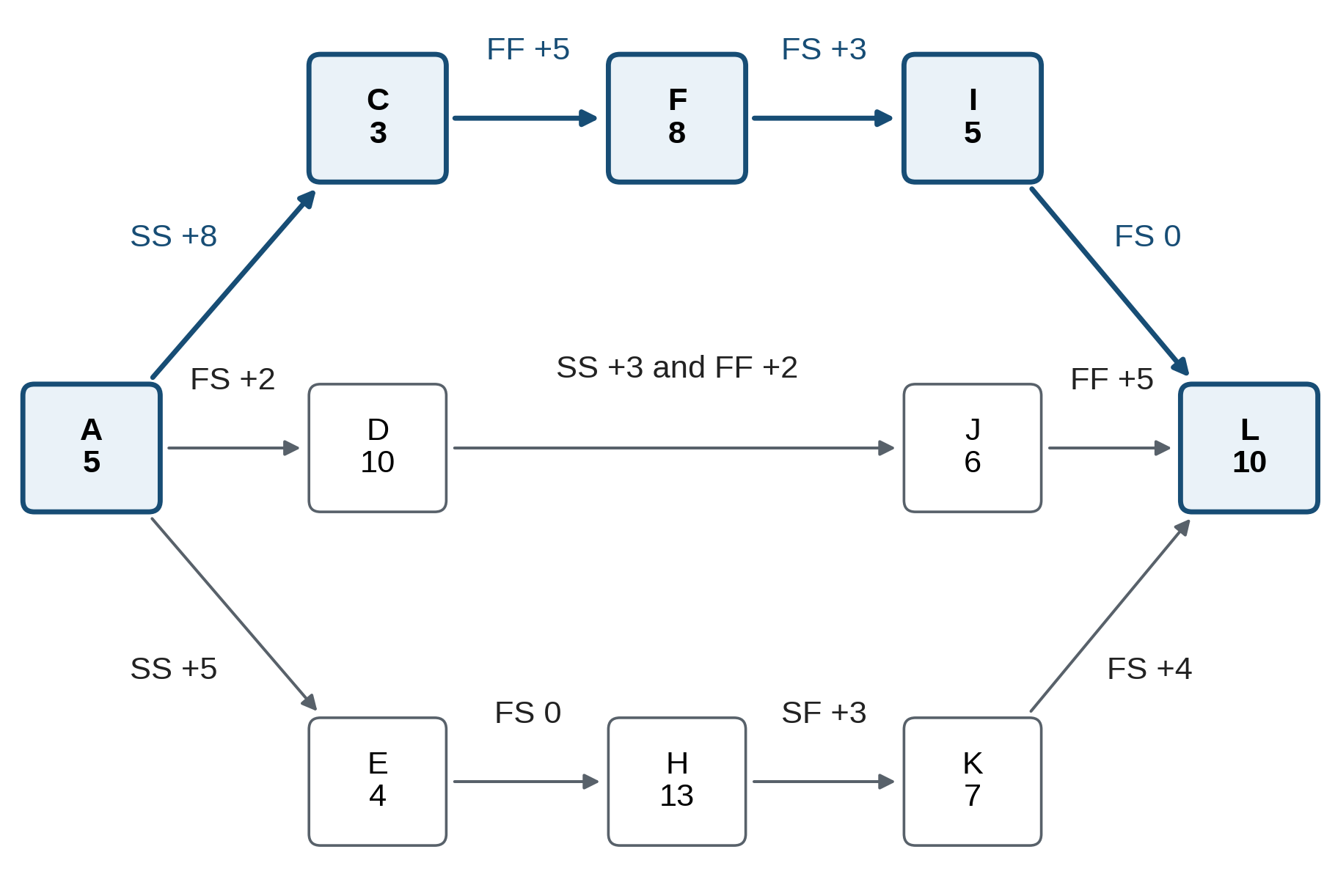
A runs from zero to five working days. The SS plus eight link to C places C at eight to eleven. C-to-F is FF plus five. F must finish at least five days after C, at sixteen; its eight-day duration places its start at eight. C and F therefore start together while finishing five days apart. F-to-I is FS plus three, so I runs from nineteen to twenty-four. I-to-L is unlabeled in the source network and is interpreted as FS zero, placing L at twenty-four to thirty-four. The controlling sequence is A–C–F–I–L through SS plus eight, FF plus five, FS plus three and FS zero. Adding those activity durations would ignore the actual endpoint relationships.
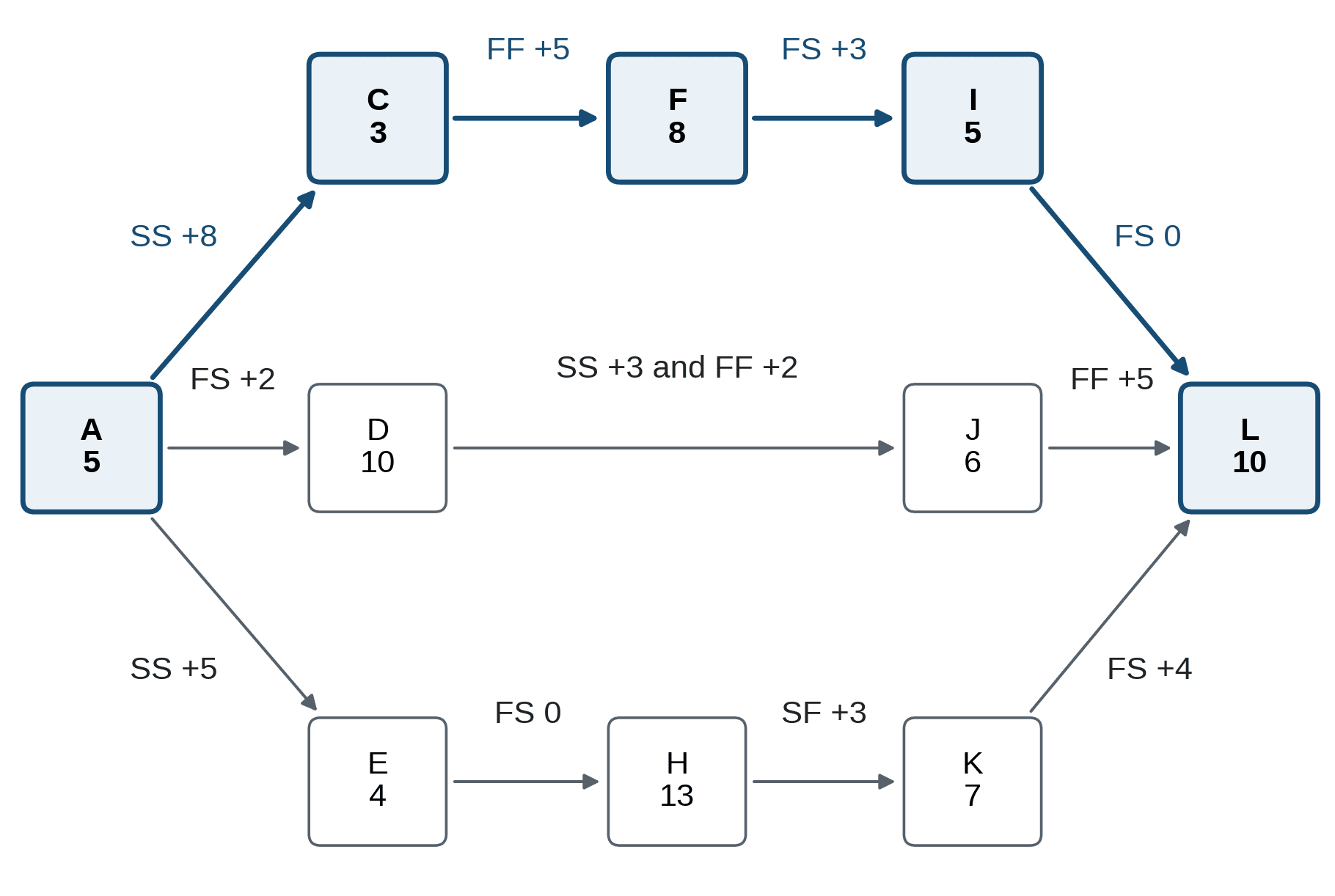
| From | To | Relationship |
|---|---|---|
| A | C | SS +8 |
| A | D | FS +2 |
| A | E | SS +5 |
| C | F | FF +5 |
| D | J | SS +3 and FF +2, both applying |
| E | H | FS 0 |
| F | I | FS +3 |
| H | K | SF +3 |
| I | L | FS 0, interpreted unlabeled arrow |
| J | L | FF +5 |
| K | L | FS +4 |
J must satisfy two conditions from D
D begins two days after A finishes and runs from seven to seventeen. D-to-J has SS plus three and FF plus two. The SS condition permits J to start at ten. The FF condition requires J to finish at least at nineteen; J's six-day duration therefore requires a start of thirteen. Select thirteen because both conditions must hold. J runs from thirteen to nineteen. The calculation is the maximum of seven plus three and seventeen plus two minus six. FF plus two is controlling here. Selecting ten would respect the start condition while breaking the finish condition. A relationship with a positive lag means at least that interval; it does not require an exact gap if another condition is stronger.
K can begin before H under the stated SF link
E begins five days after A starts and runs from five to nine. H follows E and runs from nine to twenty-two. H-to-K is SF plus three: K must finish at least three days after H starts. H starts at nine, so K cannot finish before twelve. K lasts seven days, giving its early interval of five to twelve. K starting before H is valid under this relationship because the restriction concerns H's start and K's finish. Changing the link to finish-to-start would describe a different network. This is why checking endpoint inequalities is more reliable than assuming every arrow means the next activity waits for the previous one to finish.
H
- Starts at 9
- Finishes at 22
- Duration 13 working days
K
- Starts at 5
- Finishes at 12
- 12 = 9 + 3 satisfies SF +3
L takes the strongest of three incoming conditions
I's finish requires L to start at twenty-four. J-to-L is FF plus five: J finishes at nineteen, so L must finish at least at twenty-four. Since L lasts ten days, this permits a start at fourteen. K-to-L is FS plus four, requiring a start at twelve plus four, or sixteen. The maximum of twenty-four, fourteen and sixteen is twenty-four, giving a project finish of thirty-four working days. Working backward, J's latest start is thirty-four minus five minus six, or twenty-three. Reversing both D-to-J conditions gives D a latest start of seventeen. K must finish by L's latest start of twenty-four minus four, so its latest finish is twenty and its latest start thirteen. Reversing H-to-K then gives H a latest start of twenty minus three, or seventeen. The complete table gives A, C, F, I and L zero total float. D and J have ten days, while E, H and K have eight. These are fixed-duration shift allowances. An isolated duration change still needs recalculation through the relevant start and finish restrictions.
| Activity | Duration | ES | EF | LS | LF | TF |
|---|---|---|---|---|---|---|
| A | 5 | 0 | 5 | 0 | 5 | 0 |
| C | 3 | 8 | 11 | 8 | 11 | 0 |
| D | 10 | 7 | 17 | 17 | 27 | 10 |
| E | 4 | 5 | 9 | 13 | 17 | 8 |
| F | 8 | 8 | 16 | 8 | 16 | 0 |
| H | 13 | 9 | 22 | 17 | 30 | 8 |
| I | 5 | 19 | 24 | 19 | 24 | 0 |
| J | 6 | 13 | 19 | 23 | 29 | 10 |
| K | 7 | 5 | 12 | 13 | 20 | 8 |
| L | 10 | 24 | 34 | 24 | 34 | 0 |
Key takeaways
- The engineering network takes thirty-four working days.
- J starts at thirteen because its FF condition is stricter than its SS condition.
- K's interval of five to twelve satisfies the SF +3 condition from H's start at nine.
- I controls L's start at twenty-four; the other two incoming conditions also hold.