Keep every original arrow
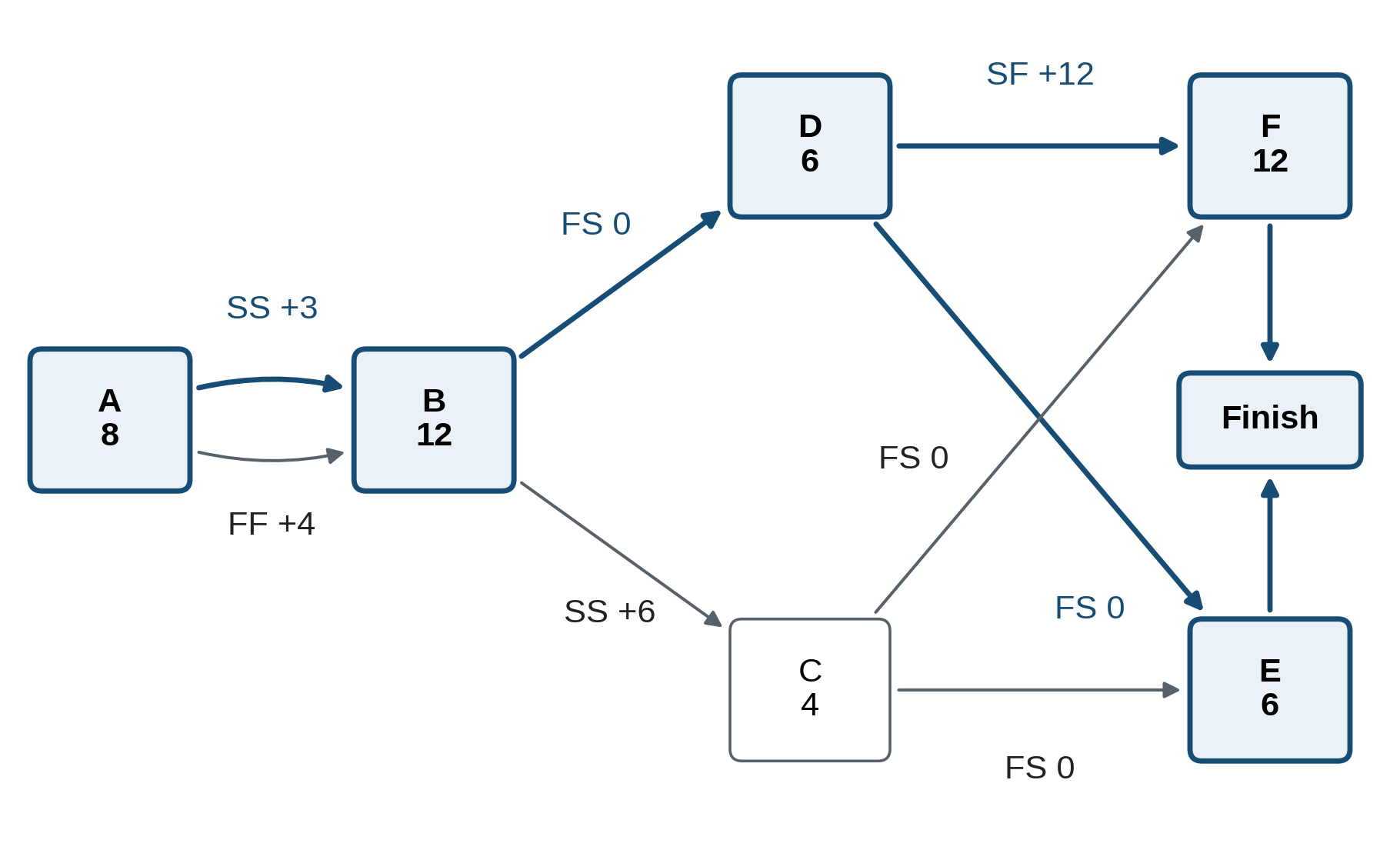
A lasts eight time units and begins at zero. B lasts twelve and has two incoming restrictions from A: SS plus three and FF plus four. The SS condition requires B to start at least at three. The FF condition requires B to finish at least at twelve, allowing a start at zero for a twelve-unit activity. The stronger restriction is three, so B runs from three to fifteen. B-to-D is FS zero, and B-to-C is SS plus six. C-to-E is labeled FS zero. The completed analysis interprets the unlabeled diagonal D-to-E and C-to-F arrows as FS zero. D-to-F is SF plus twelve. The crossing diagonal lines are not a junction, and the final milestone requires both E and F. The diagram supplies no time unit, so these results stay in time units.
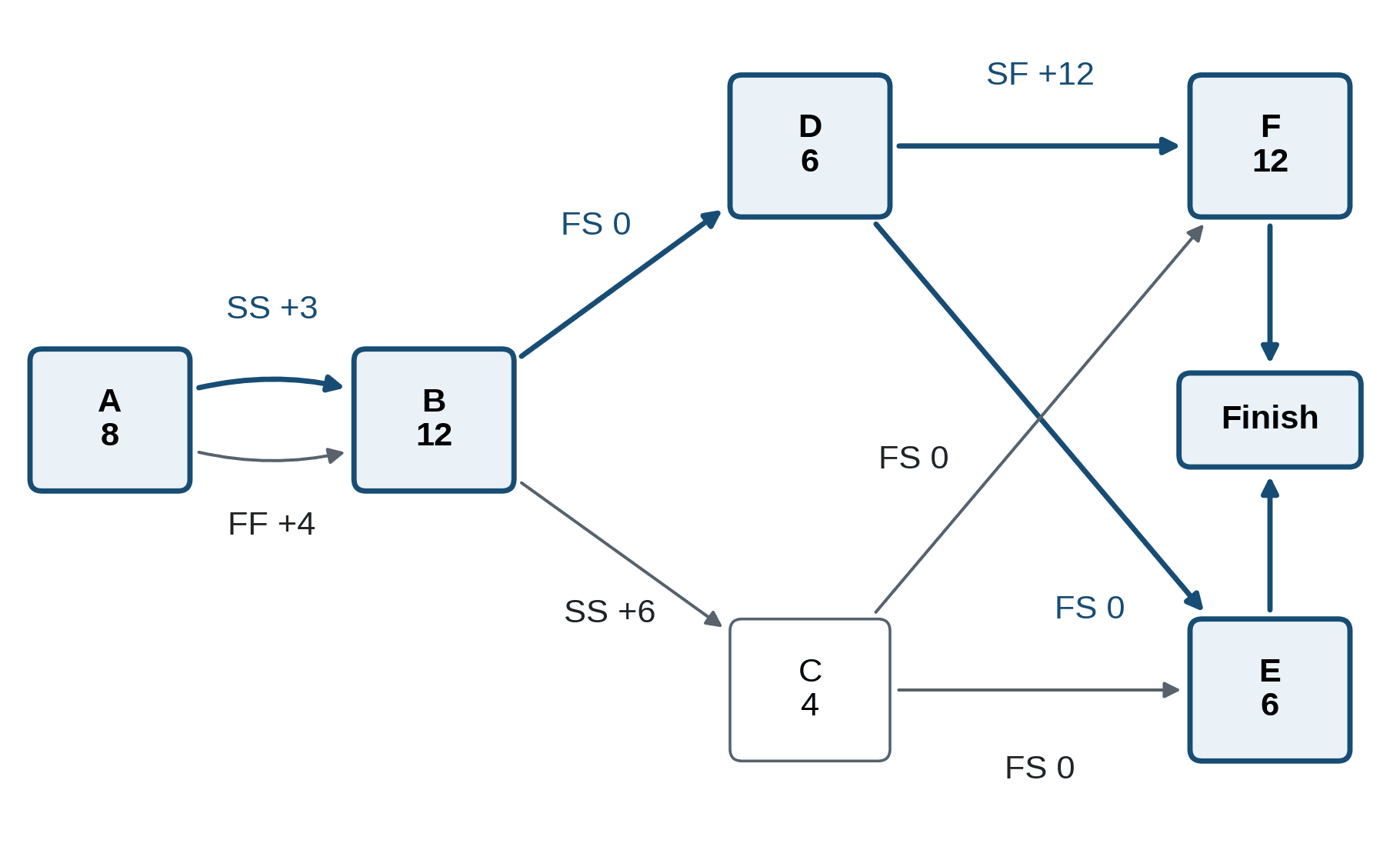
| From | To | Relationship |
|---|---|---|
| A | B | SS +3 and FF +4, both applying |
| B | C | SS +6 |
| B | D | FS 0 |
| C | E | FS 0 |
| C | F | FS 0, interpreted unlabeled arrow |
| D | E | FS 0, interpreted unlabeled arrow |
| D | F | SF +12 |
Calculate the strongest restriction forward
C begins six units after B starts, so C runs from nine to thirteen. D waits for B's finish and runs from fifteen to twenty-one. E waits for both C and D; twenty-one is the later finish, so E runs from twenty-one to twenty-seven. F waits for C to finish, requiring a start of at least thirteen. The SF plus twelve relationship from D requires F's finish to be at least D's start of fifteen plus twelve, or twenty-seven. F lasts twelve, so this second condition requires a start of at least fifteen. F therefore runs from fifteen to twenty-seven. D and F start together in this result, although their relationship is SF rather than SS. Both terminal activities finish at twenty-seven. The controlling sequences are A–B–D–E and A–B–D–F. Follow their endpoint timing: three plus twelve plus six plus six gives twenty-seven for the first; three plus twelve plus twelve gives twenty-seven for the second. Adding all activity durations on either connected route would count overlapping time incorrectly.
Key ideaSF +12 constrains F's finish using D's start. It does not make F wait for D's finish.
Use the backward pass to find C's window
Preserve completion at twenty-seven. E's latest start is twenty-one and F's is fifteen. D's latest start is the minimum of twenty-one minus six and fifteen, which is fifteen. C must finish by E's start at twenty-one and F's start at fifteen; with a four-unit duration, its latest start is eleven. B's latest start is the minimum of fifteen minus twelve and eleven minus six, giving three. Reversing both A-to-B conditions then keeps A's latest start at zero. C is the only activity with positive total float: eleven minus nine gives two units. Its free float is the minimum of twenty-one minus thirteen and fifteen minus thirteen, also two. A, B, D, E and F have zero total and free float.
| Activity | Duration | ES | EF | LS | LF | TF | Free float |
|---|---|---|---|---|---|---|---|
| A | 8 | 0 | 8 | 0 | 8 | 0 | 0 |
| B | 12 | 3 | 15 | 3 | 15 | 0 | 0 |
| C | 4 | 9 | 13 | 11 | 15 | 2 | 2 |
| D | 6 | 15 | 21 | 15 | 21 | 0 | 0 |
| E | 6 | 21 | 27 | 21 | 27 | 0 | 0 |
| F | 12 | 15 | 27 | 15 | 27 | 0 | 0 |
Key takeaways
- Both A-to-B conditions hold, with SS +3 controlling B's start.
- F finishes at twenty-seven because of the SF +12 condition from D's start.
- The project has two controlling sequences and finishes at twenty-seven time units.
- C alone has positive float: two units total and free.