Build the early schedule through D, F and G
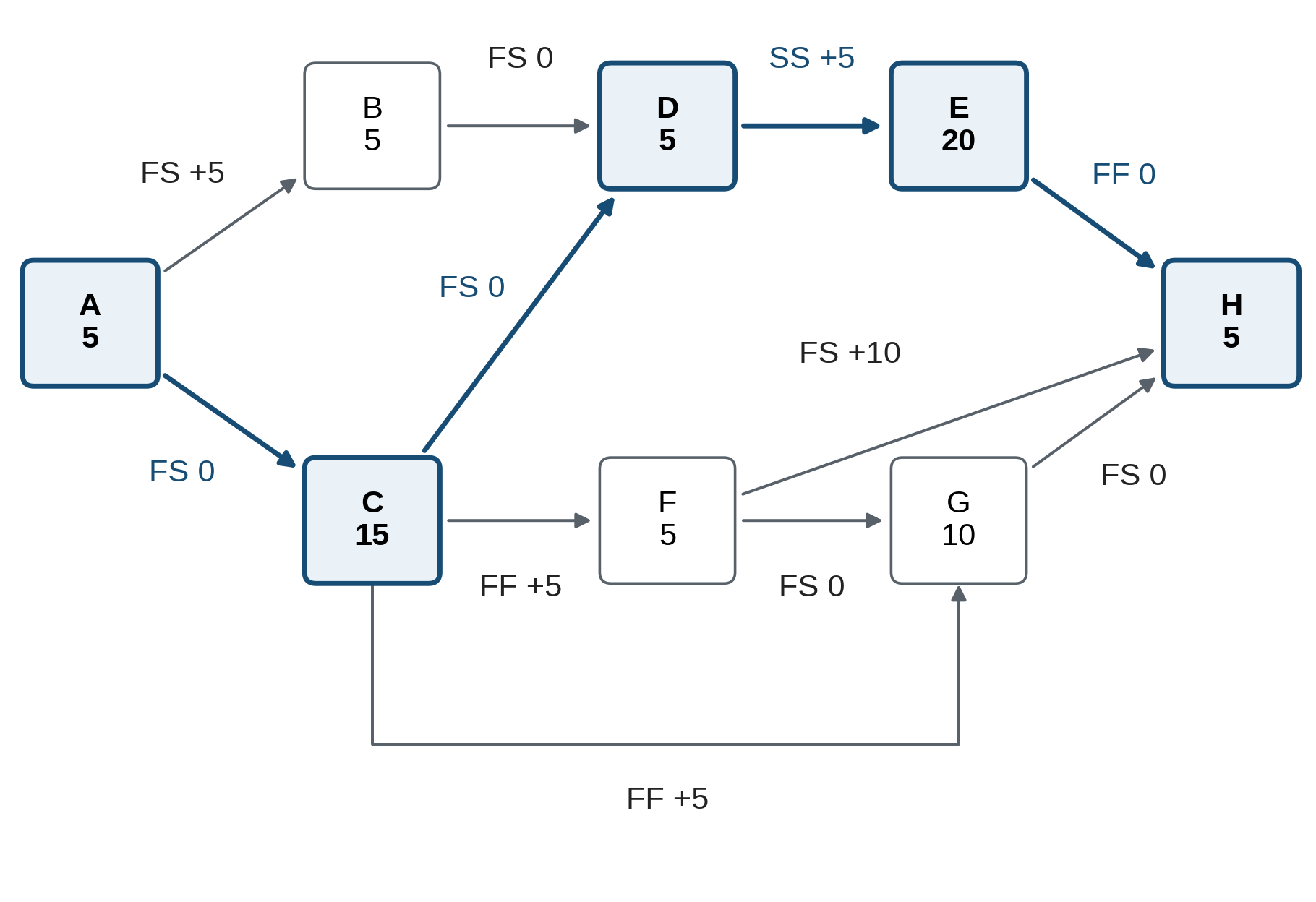
A runs from zero to five days. B has FS plus five after A, so it runs from ten to fifteen. C has ordinary FS after A and runs from five to twenty. D waits for both B and C; C controls its start at twenty, so D finishes at twenty-five. E starts five days after D starts because their relationship is SS plus five. E runs from twenty-five to forty-five. D also finishes at twenty-five because its duration happens to be five, but that coincidence does not change the SS relationship. C-to-F is FF plus five. C finishes at twenty, so F must finish no earlier than twenty-five. F lasts five days and runs from twenty to twenty-five. C-to-G also has FF plus five. G's ten-day duration would permit fifteen to twenty-five under that condition alone. G must also wait for F to finish, so its actual early interval is twenty-five to thirty-five.
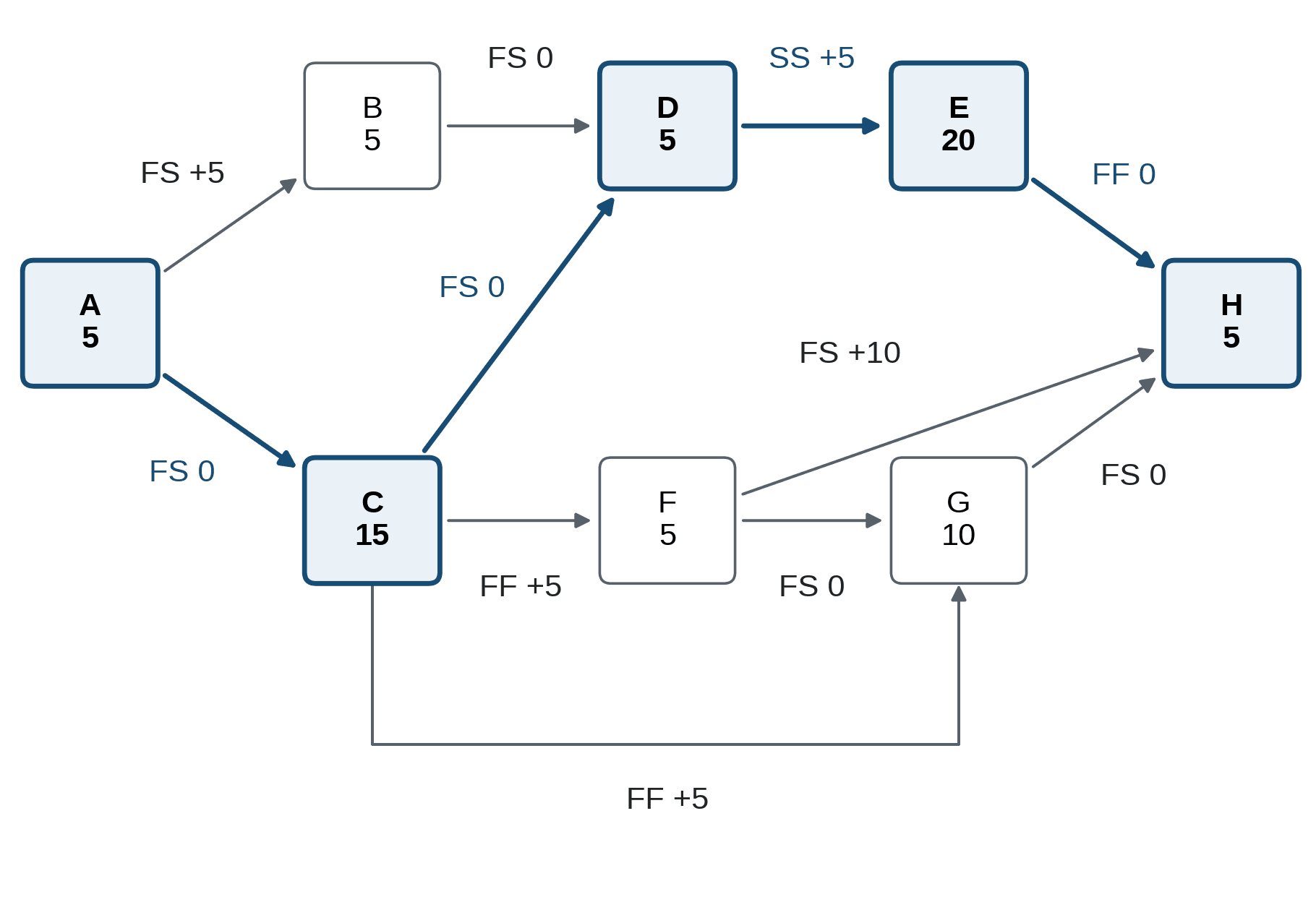
| From | To | Relationship |
|---|---|---|
| A | B | FS +5 |
| A | C | FS 0 |
| B | D | FS 0 |
| C | D | FS 0 |
| C | F | FF +5 |
| C | G | FF +5 |
| D | E | SS +5 |
| E | H | FF 0 |
| F | G | FS 0 |
| F | H | FS +10 |
| G | H | FS 0 |
Read with careThe completed analysis interprets unqualified predecessors as FS with zero lag.
H waits for the strongest endpoint restriction
H has three incoming conditions. FF zero after E requires H to finish at least at forty-five. H lasts five days, so this requires a start at forty. FS plus ten after F requires a start at twenty-five plus ten, or thirty-five. Ordinary FS after G also requires thirty-five. Select forty, making H run from forty to forty-five. The project takes forty-five days. A, C, D, E and H have zero total float, and their controlling sequence uses FS zero, FS zero, SS plus five and FF zero. H overlaps the final five days of E. Adding all five activity durations would incorrectly give fifty because it would treat the overlap as serial work.
Key ideaFF zero means the successor finish cannot precede the predecessor finish. It does not require identical starts.
Work backward from the forty-five-day finish
H's latest start is forty. G must finish by forty, giving its latest start of thirty. E-to-H is FF zero, so E can finish by H's latest finish of forty-five; E's twenty-day duration gives its latest start of twenty-five. F must finish by G's latest start of thirty. The FS plus ten link to H also requires F to finish by forty minus ten, or thirty. Both limits agree, giving F a latest start of twenty-five. D-to-E is SS plus five, so D must start by twenty-five minus five, or twenty. B must finish by D's start at twenty, giving B a latest start of fifteen. C has three successors. D limits C's latest start to twenty minus fifteen, or five. F's FF plus five condition limits it to thirty minus five minus fifteen, or ten. G's FF plus five condition limits it to forty minus five minus fifteen, or twenty. Choose the smallest, five, to preserve all three. A's two successor conditions then give a latest start of zero. B, F and G each have five days of total float; the others have zero.
| Activity | Duration | ES | EF | LS | LF | TF |
|---|---|---|---|---|---|---|
| A | 5 | 0 | 5 | 0 | 5 | 0 |
| B | 5 | 10 | 15 | 15 | 20 | 5 |
| C | 15 | 5 | 20 | 5 | 20 | 0 |
| D | 5 | 20 | 25 | 20 | 25 | 0 |
| E | 20 | 25 | 45 | 25 | 45 | 0 |
| F | 5 | 20 | 25 | 25 | 30 | 5 |
| G | 10 | 25 | 35 | 30 | 40 | 5 |
| H | 5 | 40 | 45 | 40 | 45 | 0 |
Key takeaways
- H's FF condition from E controls a forty-five-day finish.
- Backward calculations reverse the actual relationship endpoints and choose the tighter limit.
- B, F and G each have five days of total float.
- F has zero free and independent float, five interfering; G has five free.
- F and G share flexibility rather than owning two independent reserves.